
Digital wallets are now a cornerstone of modern finance. As payment activity shifts toward mobile devices, wallets are no longer just a convenience for consumers—they now support cross-border commerce, multi-currency transactions, and digital value exchange. They are increasingly relevant for businesses operating internationally.
These platforms form the infrastructure that enables electronic payments, settlement, and account-based financial interactions. Many work closely with bank accounts, payment networks, and technology platforms to support global transactions. This article examines leading digital wallet apps, highlights their key characteristics, and explores their relevance for both consumers and institutions. It also introduces Suisse Bank’s All-in-One Wallet, a solution tailored for institutional users.
Digital Wallets in Today’s Financial Environment
Digital wallets first emerged as an alternative to cash and physical cards, especially in e-commerce and mobile payments. Over time, their functionality expanded. Today, they often support:
- Multiple currencies
- Peer-to-peer transfers
- Online and in-store digital payments
- Integration with bank accounts and debit cards
For businesses and institutions, digital wallets are increasingly part of the global payments infrastructure. They support treasury operations, cross-border settlements, and platform-based business models. As a result, digital wallets are evaluated on:
- Scalability
- Interoperability
- Alignment with financial systems
Key Characteristics of Leading Digital Wallet Companies
Most top digital wallets share these traits:
- Geographic reach: Active across multiple markets and currencies
- Functional breadth: Payments, transfers, and value storage
- Integration capability: Works with merchants, platforms, and external systems
- Operational structure: Defined controls and governance frameworks
- Adaptability: Responsive to regulatory and market changes
These characteristics shape adoption by both individual users and organizations.
Comparative Table of Leading Digital Wallets
|
Wallet |
Primary Use |
Device Compatibility |
Cross-Border Support |
Multi- Currency |
Crypto Support |
Institutional Use |
|
Suisse Bank All-in-One Wallet
|
Institutional multi-currency wallet
|
Web, iOS, Android
|
Yes
|
Yes
|
Selected Crypto
|
Enterprise treasury & settlement
|
|
PayPal
|
Peer-to-peer, merchant payments
|
Web, iOS, Android
|
Yes
|
Yes
|
Limited
|
Invoicing, payment collection
|
|
Apple Pay
|
Contactless, in-app payments
|
iPhone, iPad, Apple Watch
|
Partial
|
No
|
No
|
Corporate card programs, enterprise MDM |
|
Google Pay
|
Mobile payments, credential storage
|
Android, Web
|
Yes
|
Yes
|
No
|
Loyalty programs, corporate payments
|
|
Samsung Wallet
|
Contactless, ID & credential storage
|
Samsung devices
|
Partial
|
No
|
No
|
Employee access, identity management
|
|
Alipay
|
Payments, financial services, mini-programs
|
iOS, Android
|
Yes (Asia-Pacific focus)
|
Yes
|
No
|
Cross-border commerce
|
|
WeChat Pay
|
Social commerce, in-chat payments
|
iOS, Android
|
Partial
|
No |
No |
Social-commerce integration |
|
Cash App
|
P2P payments, banking
|
iOS, Android
|
No
|
No
|
Bitcoin support
|
Small business transactions
|
Notable Statistics
- PayPal: Over $1.3 trillion in transactions processed annually; 426 million active accounts worldwide
- Apple Pay: 507 million users globally for contactless payments
- Google Pay: Over 100 billion transactions processed in last year across 40+ countries
- Alipay: 1.3 billion active users in Asia, facilitating trillions in mobile payments annually
- Cash App: 44 million monthly active users processing billions in peer-to-peer and debit card transactions
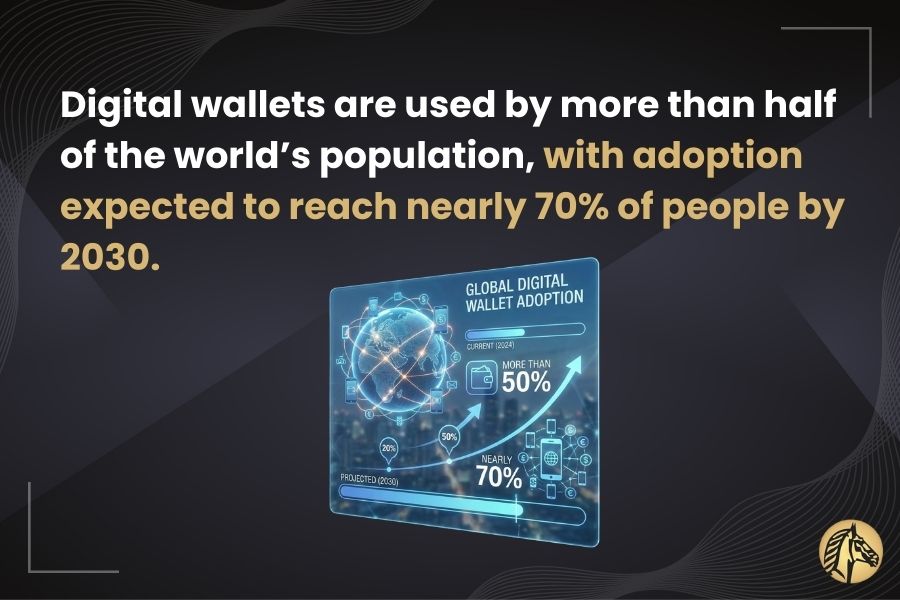
Insight: Digital wallet adoption is accelerating, driven by mobile digital payments, contactless transactions, and integration with bank accounts. Businesses increasingly leverage these wallets for international operations.
Digital Wallet Apps and Integration
Modern digital wallet apps offer more than payment capabilities—they act as hubs for financial management, loyalty programs, and even digital asset interaction. Key integration features include:
- Bank account connectivity: Direct linking to multiple accounts enables seamless money transfers and balance management
- Merchant and e-commerce integration: APIs allow wallets to plug into online platforms for checkout and payment tracking
- Platform compatibility: iOS, Android, and web apps ensure access across devices
- Digital credential storage: Tickets, loyalty cards, and corporate IDs can be stored within the wallet
These integrations position digital wallet apps as indispensable tools for both personal and enterprise financial workflows.
Detailed Wallet Provider Insights
1. Suisse Bank All-in-One Wallet
Functional Scope:
Suisse Bank’s All-in-One Wallet is designed for internationally active clients requiring consolidated access to multi-currency accounts and digital payment channels. It supports inbound and outbound transfers through established payment rails, including SWIFT, SEPA, SEPA Instant, and UK Faster Payments. The wallet also enables interaction with selected digital assets alongside fiat balances.
Unique Features:
- Segregated multi-currency accounts with a Tier-1 banking partner
- Web and mobile access with remote onboarding
- Consolidated interface for account access, payments, and digital asset interaction
Institutional Relevance:
The All-in-One Wallet is positioned as an institutional solution, supporting treasury operations, cross-border settlements, and operational consolidation. Its structure reflects a banking-aligned approach rather than a consumer-only payment application.
2. PayPal
Functional Scope:
PayPal is a globally recognized digital wallet platform that supports multi-currency transactions, enabling businesses and consumers to conduct cross-border payments efficiently. Beyond simple peer-to-peer transfers, PayPal integrates with merchants through APIs and e-commerce plug-ins, allowing seamless checkout experiences on websites and mobile apps. Additional features include invoicing, subscription billing, and mass payouts, which are essential for enterprise operations.
Unique Features:
- Fraud detection and buyer protection programs
- Integration with PayPal Credit and working capital services
- Merchant tools for recurring billing and payment tracking
Institutional Relevance:
PayPal is widely adopted by businesses for international transactions, cross-border settlements, and e-commerce operations. Its compatibility with enterprise systems allows corporations to manage invoicing, payment collections, and online payment flows, reducing friction in global commerce.
3. Apple Pay
Functional Scope:
Apple Pay enables contactless payments via Apple devices. It supports in-app purchases, online payments, and the storage of boarding passes, tickets, loyalty cards, and membership credentials within Apple Wallet. Its seamless integration within the Apple ecosystem ensures smooth transactions across multiple touchpoints.
Unique Features:
- Device-level biometric authentication (Face ID, Touch ID) for secure payments
- Apple Cash for P2P transfers within iMessage
- Tokenized card transactions that protect sensitive financial data
Institutional Relevance:
Apple Pay is compatible with corporate card programs and enterprise mobile device management (MDM) systems, allowing organizations to integrate employee expense management, secure payment workflows, and mobile procurement. Its consumer-friendly interface also enhances employee adoption and cross-device usability.
4. Google Pay / Google Wallet
Functional Scope:
Google Pay (previously Google Wallet) provides NFC-enabled mobile payments for in-store purchases, as well as online checkout solutions. It also functions as a credential management system, storing loyalty cards, transit passes, event tickets, and gift cards. Google Pay integrates with Google services, including Gmail and Google Play, streamlining digital payments across the Android ecosystem.
Unique Features:
- Integration with third-party apps and banking services
- Real-time notifications for transactions and loyalty updates
- Tap-to-pay functionality for Android devices without requiring a physical card
Institutional Relevance:
Google Pay aligns with enterprise mobility programs, supporting company-issued devices, loyalty management, and corporate rewards programs. Its API integrations allow businesses to embed payment solutions within apps or digital platforms, supporting scalable business operations.
5. Samsung Wallet
Functional Scope:
Samsung Wallet combines contactless payments with identity management, enabling users to store digital passes, boarding passes, membership credentials, and government-issued IDs securely. It supports NFC-based transactions at compatible merchant terminals and ensures consistent cross-device usability within the Samsung ecosystem.
Unique Features:
- Samsung Knox security platform for device-level protection
- Unified platform for payments, IDs, and tickets
- Cross-device experience for Samsung smartphones, tablets, and wearables
Institutional Relevance:
Samsung Wallet supports enterprise use cases such as employee access control, corporate ID verification, and integration with internal workflows for secure payments. Businesses adopting Samsung devices benefit from the wallet’s secure infrastructure and streamlined identity and payment management.
6. Alipay
Functional Scope:
Alipay, operated by Ant Group, is a comprehensive digital commerce platform widely used in Asia. It supports retail and service payments, transfers, savings accounts, credit services, and a mini-program ecosystem for third-party apps. Users can pay bills, make in-store purchases, book travel, and access lifestyle services through the platform.
Unique Features:
- QR-code-based payments for merchants
- Integration with financial products like microloans and insurance
- Mini-programs for e-commerce, entertainment, and utility services
Institutional Relevance:
Alipay is essential for companies engaged in cross-border commerce in Asia-Pacific. Businesses can leverage Alipay to collect payments, integrate with local merchants, and access consumer spending insights. Its ecosystem approach supports enterprise operations and localized financial management.
7. WeChat Pay
Functional Scope:
Embedded within Tencent’s WeChat app, WeChat Pay enables in-chat fund transfers, bill payments, QR-code transactions, and integration with mini-programs. It combines social interaction with commerce, allowing users to pay friends, shop online, or interact with services directly within messaging platforms.
Unique Features:
- Seamless peer-to-peer transfers within WeChat
- QR-code payments for merchants and offline transactions
- Integration with WeChat mini-programs for commerce, food delivery, and ticketing
Institutional Relevance:
WeChat Pay is ideal for companies leveraging social commerce, particularly in Asia. Businesses can integrate customer interaction with payment workflows, embedding payments into marketing campaigns and loyalty programs. Its ecosystem fosters engagement while facilitating commercial transactions.
8. Cash App
Functional Scope:
Cash App is a U.S.-focused mobile-first wallet supporting instant peer-to-peer transfers, mobile payments, and debit card management. It also provides Bitcoin and cryptocurrency support, enabling users to buy, sell, convert, and hold digital assets alongside fiat currency.
Unique Features:
- Cash Card for instant access to funds
- Bitcoin wallet and Bitcoin transaction functionality
- Stock trading and investment features for individual users
Institutional Relevance:
While consumer-oriented, Cash App demonstrates the growing trend of integrated mobile wallets that blend payments, banking, and digital asset management. Small businesses and freelancers benefit from its fast payment capabilities and ease of access to multiple financial services within one app.
Security, Controls, and Operational Considerations
Leading wallets implement multiple safeguards:
- Transaction monitoring frameworks
- Multi-factor authentication
- Segregated accounts or balances
- Compliance with regional and international regulations
These measures ensure both consumer and institutional trust.
Business Applications of Digital Wallets
Digital wallets increasingly support corporate operations, including:
- Collecting payments from international clients
- Paying suppliers across borders
- Managing multi-currency balances
- Supporting remote or platform-based business models
Wallets with broader functionality integrate into treasury and accounting workflows, improving efficiency and transparency.
Choosing the Right Digital Wallet for Your Needs

When selecting a digital wallet, consider these SEO-relevant factors:
1. Mobile Payments & Contactless Wallets
Apple Pay, Google Pay, and Samsung Wallet support NFC-based contactless transactions and in-app payments.
2. Cross-Border Payments & Multi-Currency Support
PayPal, Alipay, and Suisse Bank All-in-One Wallet Cash App and Suisse Bank’s All-in-One Wallet support selected digital asset interactions.
3. Cryptocurrency & Digital Asset Wallets
Cash App and Suisse Bank’s All-in-One Wallet support selected digital asset interactions.
4. Security & Compliance
Users often evaluate wallets based on authentication methods, governance frameworks, and regulatory alignment.
5. Business Integration & Scalability
Enterprise users prioritize API access, invoicing tools, and treasury integration.
Suisse Bank’s All-in-One Wallet
Designed for international clients:
- Multi-Currency Account Access: Segregated accounts with a Tier-1 banking partner; SWIFT, SEPA, SEPA Instant, UK Faster Payments
- Cross-Border Payments: Inbound/outbound transfers for distributed operations
- Digital Asset Interaction: Selected cryptocurrency support
- Access & Onboarding: Web and mobile access, remote onboarding
- Positioning: Consolidation, international reach, and institutional usability
Expanded Trends Among Digital Wallets
- Service Convergence: Payments, bank accounts, and digital assets within unified platforms
- Business Adoption: Support for treasury and operational workflows
- Global Orientation: Cross-border functionality driving adoption
- Platform Integration: Embedding within commerce and technology ecosystems
- AI & Fraud Prevention: AI-driven transaction monitoring
- BNPL Integration: Buy Now, Pay Later capabilities in wallets
- CBDC Compatibility: Preparing for central bank digital currencies
- Subscription & Platform Models: Support for recurring payments and platform-based services
- Wallet App Ecosystems: Integration of loyalty programs, ticketing, and corporate IDs into digital wallet apps
Shaping the Future of Digital Payments: Key Takeaways for Consumers and Businesses
Digital wallets have become essential tools in modern finance. Platforms such as PayPal, Google Pay, Apple Pay, and Cash App enable seamless digital payments, account management, debit card transactions, and contactless payments, often consolidating multiple functions into a single, convenient interface for both consumers and businesses.
Suisse Bank’s All-in-One Wallet exemplifies an institutional approach, offering multi-currency accounts, cross-border capabilities, and digital asset interaction within a secure and structured banking framework. As digital wallet apps continue to evolve, factors such as interoperability, operational structure, and global usability remain critical for adoption and long-term relevance.
By integrating mobile payments, bank accounts, debit cards, and digital asset support, modern digital wallets are simplifying transactions and shaping the future of finance for individuals and organizations alike.