
International bank transfers enable individuals and businesses to move funds across borders as part of global financial activity. As digital commerce, remote services, and cross border trade continue to expand, the ability to send money internationally has become a practical requirement rather than a specialized function.
Unlike domestic transfers, international transfers involve foreign currency, multiple banking systems, and regulatory frameworks that vary by destination country. These differences influence processing time, total cost, settlement reliability, and payments performance.
Suisse Bank assesses these variables as part of a broader cross border payments framework, recognizing that transfer outcomes depend on external banking networks, intermediary institutions, and regulatory conditions rather than a single system or provider.
Understanding how international bank transfers work is therefore essential for managing expectations, timelines, and financial exposure.
Benefits of International Money Transfers
International money transfers support a wide range of personal and commercial needs, from education expenses and relocation costs to supplier payments and professional services.
From Suisse Bank’s perspective, these transfers support globally active clients by enabling structured movement of funds across borders, while requiring careful consideration of settlement risk, cost predictability, and compliance exposure.
Online banking platforms and mobile applications have simplified initiation and tracking, though transparency and verification remain essential.
How International Bank Transfers and Wire Transfer Systems Operate
International transfers rely on standardized messaging systems, regulatory checks, and settlement processes that differ substantially from domestic wires. Multiple banks and payment networks are typically involved.
Core Transfer Process
The international wire transfer process generally involves initiation, interbank communication, and settlement. Once a sender submits a transfer request, the sending institution verifies the information and transmits instructions to the receiving bank through established financial messaging networks, such as SWIFT.
To initiate an international electronic funds transfer, senders must provide accurate recipient information, including full legal name, address, bank details, and an account number or IBAN. Inaccurate information remains one of the most common causes of delays and payment failures.
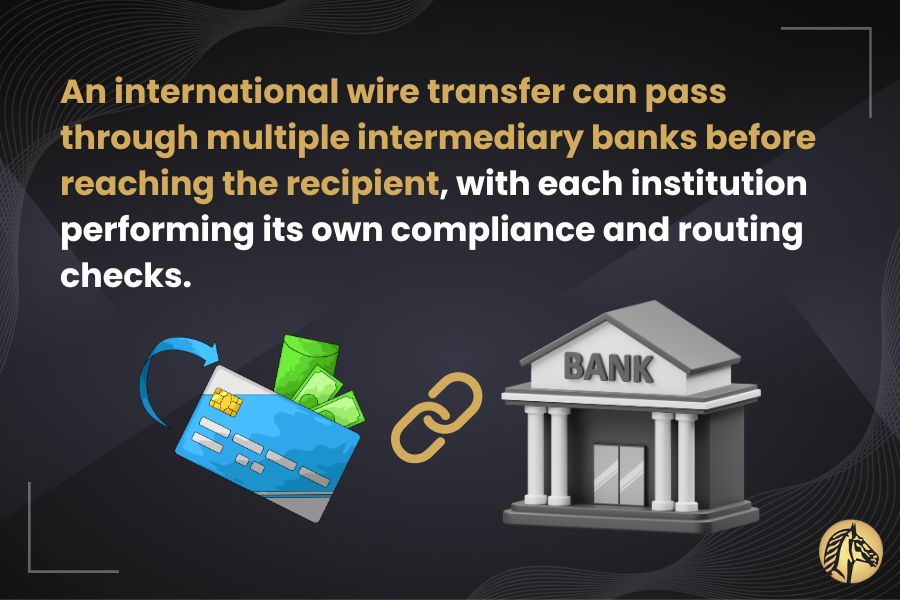
Funds may pass through one or more intermediary banks before reaching the receiving institution. Once settlement is completed, the recipient’s bank credits the funds. International wire transfers are typically irreversible once processed, making accuracy and confirmation essential.
Transfers may be initiated through online banking platforms, mobile applications, or branch networks. Obtaining confirmation and tracking references is considered best practice.
Exchange Rate and Foreign Currency
Currency conversion plays a central role in international transfers and directly affects total cost. Most transfer providers apply exchange rate markups rather than using mid-market reference rates.
Suisse Bank recognizes that exchange rate spreads, intermediary deductions, and settlement timing can materially influence cash flow and transfer efficiency, particularly for clients with recurring international payment activity.
Currency conversion can also extend processing timelines, especially when multiple intermediaries are involved. Understanding foreign currency exposure is essential for planning international payments and managing budget expectations.
Bank Account Requirements
Both the sender and recipient must hold a valid bank account. Account type, jurisdiction, and verification status may affect transfer limits, processing timelines, and applicable fees.
Accurate bank identification details, including routing information or IBANs, are required. Discrepancies between account holder names and registration details may result in delays or rejected transfers.
Some providers support transfers funded from savings accounts or alternative accounts, which may offer different cost structures compared to traditional wire transfers.
Account Number and Verification
International wire transfers require strict account identification and verification under anti money laundering regulations.
To process a transfer, banks typically require:
- The recipient’s full legal name and registered address
- A valid account number or IBAN
- Accurate bank identification details
Errors in this information can lead to payment failures, returned funds, or extended review periods, particularly where intermediary banks are involved.
Destination Country and Transfer Restrictions
The destination country plays a significant role in international transfer processing. Some jurisdictions impose restrictions on inbound transfers, documentation requirements, or currency controls.
Local bank holidays frequently delay international transfers, as banks typically do not process payments on public holidays. Transfers initiated outside standard banking hours may be delayed by one additional business day or more.
Bank Transfer Fees and Cost Structure
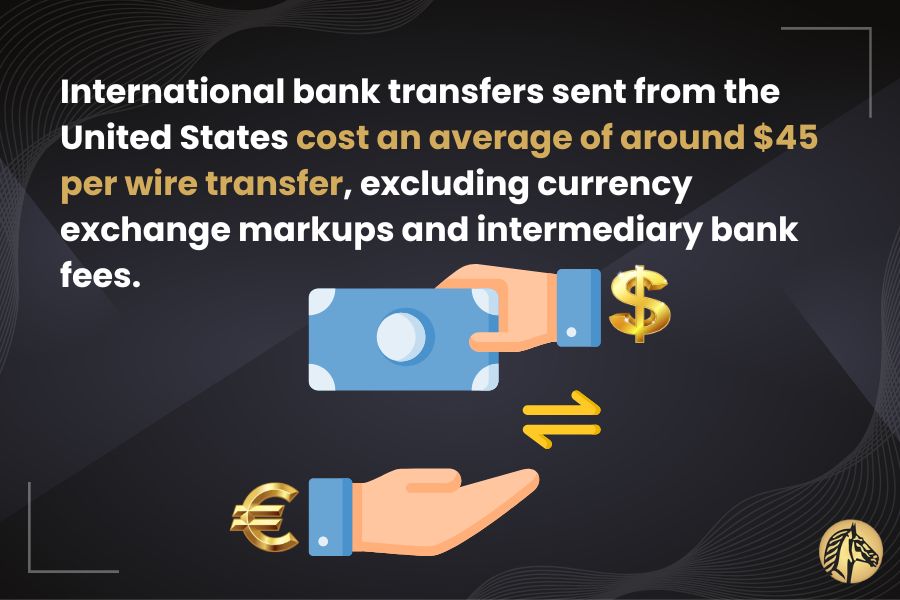
International wire transfer fees vary significantly. Sending banks typically apply an outgoing wire transfer fee, which varies depending on the institution, destination country, and transfer method.
Intermediary banks may deduct additional charges as part of the routing process, and recipient banks may apply separate incoming transfer fees. These costs are often deducted directly from the transferred amount, reducing the final sum received.
As a result, the total cost of an international transfer is frequently distributed across multiple parties, making cost predictability more important than headline pricing alone.
Suisse Bank evaluates these layered fee structures as part of overall transfer transparency, recognizing that cost predictability is often more critical than headline pricing alone.
International Payments and Trade
International transfers play a central role in global trade and cross-border commerce. Businesses rely on them to manage supplier payments, professional services, and contractual obligations.
Understanding payment flows supports better cash flow planning, settlement forecasting, and exposure management.
Security and Fraud Prevention
International transfers carry higher fraud risk due to jurisdictional complexity.
Suisse Bank approaches fraud prevention as a shared responsibility between institutions, networks, and clients, supported by AML, KYC, and transaction monitoring frameworks.
Security Infrastructure
Security is a core component of international transfer operations. Cross border transactions carry higher fraud risk than domestic transfers due to jurisdictional complexity and communication gaps.
Fraud Prevention and Monitoring
Fraud prevention tools include real time monitoring, behavioral analysis, and automated risk scoring. AML and KYC checks may delay transfers but are essential for reducing exposure to fraudulent transactions.
Transfer Methods and Options
International transfers can be initiated through online banking, mobile apps, debit cards, and other payment methods. Debit cards are often lower cost than credit cards when funding transfers.
Different methods offer tradeoffs between speed and cost. Same day settlement may be available through select services, while batch processed ACH transfers typically take three to five business days but are lower in cost.
Transfer Timelines
International wire transfers generally take one to five business days. Processing time varies depending on the banks involved, destination country, currency conversion requirements, and intermediary banks.
Fintech services often provide money faster than traditional banks, with delivery speeds ranging from instant to one or two days. Speed and cost are closely related, with faster transfers often incurring higher fees or exchange rate markups.
Tracking and Monitoring Transfers
Most banks and service providers offer tools to track transfers through online banking or mobile apps. Monitoring transfer status helps identify delays early.
If delays occur, following up with the sending bank is recommended. Notifying the recipient about expected timelines and required information supports coordination.
International Money Transfer Services
Alternative providers offer international transfer services alongside traditional banks. Delivery speed, fee structures, and exchange rate policies vary by provider and destination.
Comparing providers by corridor rather than by headline pricing helps set realistic expectations.
Compliance and Regulations
Compliance with AML and KYC regulations is mandatory. Requirements vary depending on country and service provider. Understanding compliance obligations helps individuals and businesses avoid penalties, delays, and rejected transfers.
Best Practices for International Transfers
Best practices include verifying account details, understanding fees, and confirming exchange rates before sending funds. Comparing providers by destination country, delivery speed, and total cost improves outcomes. Awareness of local regulations and holidays reduces delays.
Common Mistakes to Avoid
Common mistakes include incorrect account details, insufficient funds, and underestimating fees. Careful review of transfer information helps prevent errors. Providers often offer guidance to reduce mistakes.
Operational Perspective Within Suisse Bank
Within Suisse Bank’s operational framework, international wire transfer activity is assessed as part of a broader cross border payments structure. The use of wire transfer systems, program banks, and intermediary banks is evaluated based on governance standards, compliance exposure, and operational risk.
International payments are treated as enabling infrastructure rather than outcome driven solutions. Responsibility for selecting a service provider, managing fees, and overseeing compliance obligations remains with the client.