
Why Enterprise Risk Management Matters for Business Owners
Business owners today operate in environments shaped by regulatory complexity, market volatility, technological change, and increasing cross‑border exposure. Strategic decisions are influenced not only by commercial objectives, but also by considerations related to operational resilience, compliance obligations, and long‑term sustainability. Within this landscape, enterprise risk management (ERM) is commonly examined as a governance framework for understanding and managing uncertainty across an organization.
Enterprise risk management is a structured, top‑down discipline designed to support the identification, assessment, and oversight of risks that may affect an organization’s objectives. Rather than focusing solely on individual threats, ERM enables a consolidated view of risk across functions, geographies, and activities. Its relevance lies in supporting informed decision‑making, transparency, and accountability within defined governance arrangements.
At Suisse Bank, enterprise risk management is not viewed as a universal solution or a prescriptive model. It is assessed as part of a broader governance and control framework, the design and application of which must reflect the size, complexity, and regulatory context of each organization. Business owners are encouraged to consider ERM within this broader perspective, recognising that its role is to support oversight and resilience rather than to eliminate uncertainty.
Understanding Enterprise Risk Management
Most organizations already undertake some form of risk management, often through discrete or function‑specific processes. Enterprise risk management refers to a more coordinated approach that brings together risk identification, assessment, and oversight across the organization. Risks considered within ERM frameworks may include financial, operational, strategic, regulatory, technological, and reputational factors.
An ERM framework seeks to move risk management away from fragmented or siloed practices by establishing common principles, terminology, and reporting structures. This enables risks to be considered in relation to strategy, governance, and operational decision‑making. From an institutional perspective, ERM is understood as a continuous and iterative process rather than a one‑time exercise.
At Suisse Bank, ERM is approached as a governance discipline rather than a performance tool. Its purpose is to support clarity around risk exposure, risk ownership, and escalation processes, while allowing organizations to make informed decisions within their defined risk appetite.
The Role of Governance in Enterprise Risk Management
Effective enterprise risk management is anchored in governance. Without clear oversight structures and defined accountability, risk frameworks may lack practical relevance or consistency.
From a governance standpoint, ERM typically involves:
- Defined roles and responsibilities at senior management and operational levels
- Clear escalation and reporting mechanisms
- Documented risk policies and procedures
- Ongoing oversight by boards, leadership teams, or designated risk committees
Senior management is generally responsible for identifying and managing risks within their areas of responsibility, while governing bodies provide oversight and challenge. Regulatory frameworks in many jurisdictions reinforce the importance of this separation between management responsibility and supervisory oversight.
At Suisse Bank, governance is treated as a foundational element of any ERM framework. Business owners considering ERM are encouraged to establish governance arrangements that are proportionate, clearly documented, and aligned with applicable regulatory expectations. This approach supports accountability while maintaining flexibility in how risk processes are implemented.
ERM Frameworks and Standards
Recognised ERM frameworks and standards provide reference points for organizations seeking to formalise their risk management practices. These frameworks outline common components and processes that support consistency and comparability, while allowing for adaptation to different business models.
One widely referenced model is the COSO ERM framework, which sets out principles for integrating risk considerations into strategy, operations, reporting, and compliance. Such frameworks are often used as benchmarks rather than as fixed templates.
From Suisse Bank’s perspective, the use of recognised frameworks is assessed in terms of their suitability for the organization’s structure, regulatory environment, and governance maturity. Alignment with established standards may support clarity and discipline, but implementation remains a matter of judgement rather than compliance alone.
Identifying Risks Across the Organization
Risk identification is a core component of enterprise risk management. It involves the systematic consideration of internal and external factors that may affect an organization’s objectives.
Common categories of risk considered within ERM frameworks include:
Strategic risks
Risks associated with business decisions, market dynamics, or changes in the external environment.
Financial risks
Risks related to liquidity, funding structures, credit exposure, or market movements.
Operational risks
Risks arising from internal processes, systems, people, or third‑party relationships.
Regulatory and compliance risks
Risks linked to evolving legal, regulatory, or supervisory requirements across jurisdictions.
Technology and cyber risks
Risks associated with system availability, data protection, cybersecurity, and technology integration.
Suisse Bank encourages structured and documented risk identification processes that draw input from across the organization. Such processes are typically reviewed periodically to reflect changes in business activities, operating environments, and regulatory expectations.
Assessing and Prioritising Risks
Once risks have been identified, ERM frameworks focus on assessment and prioritisation. Not all risks carry the same potential significance, and disciplined evaluation supports proportionate oversight.
Risk assessment commonly considers:
- Likelihood of occurrence
- Potential impact on financial position, operations, or reputation
- Speed of onset and detectability
- Existing controls and mitigation measures
This assessment supports the prioritisation of risks that may warrant enhanced monitoring, escalation, or additional controls. From an institutional perspective, Suisse Bank emphasizes proportionality: responses to risk should align with the organization’s defined risk appetite and governance capacity.
Risk Management Processes Within an ERM Framework
Enterprise risk management is supported by defined risk management processes that provide structure, consistency, and traceability across the organization. These processes are not intended to be static or overly prescriptive; rather, they establish a common foundation for how risks are identified, assessed, managed, and reported over time.
Within an ERM framework, risk management processes typically include:
- Risk identification and documentation, supported by standardised taxonomies, registers, or inventories that enable consistent classification and comparison of risks across business units.
- Risk assessment methodologies, which define how likelihood, impact, and control effectiveness are evaluated, allowing risks to be prioritised using common criteria.
- Control design and evaluation, ensuring that mitigating measures are clearly documented, proportionate, and aligned with the organisation’s governance structure.
- Escalation and decision pathways, which clarify when risks should be elevated to senior management or governing bodies for review or action.
- Monitoring and reporting mechanisms, including periodic reviews, key risk indicators, and management reporting that support ongoing oversight.
From Suisse Bank’s institutional perspective, well‑defined processes contribute to transparency and accountability, particularly in complex or regulated environments. Business owners are encouraged to design risk management processes that are proportionate to their operating model and capable of evolving as business activities, regulatory expectations, and external conditions change.
Establishing an Enterprise Risk Management Program
An enterprise risk management program refers to the formalisation of ERM principles, governance structures, and processes into a coordinated and repeatable organisational practice. While frameworks provide conceptual guidance, a program translates those concepts into operational arrangements that can be applied consistently over time.
An ERM program typically encompasses:
- Defined governance structures, including oversight responsibilities at board or senior management level and clearly assigned risk ownership across the organisation.
- Documented policies and procedures, setting out expectations for risk identification, assessment, escalation, and reporting.
- Roles and responsibilities, clarifying accountability for managing risks at both enterprise and operational levels.
- Supporting tools and reporting, such as risk registers, dashboards, and periodic management reports that facilitate informed oversight.
- Review and assurance mechanisms, ensuring that the program remains aligned with internal governance standards and external regulatory expectations.
At Suisse Bank, enterprise risk management programs are assessed with a focus on proportionality, governance discipline, and regulatory alignment. Business owners are encouraged to view ERM programs as evolving governance arrangements rather than fixed implementations. The scope, maturity, and resourcing of an ERM program are ultimately determined by the organisation, taking into account its complexity, risk profile, and applicable regulatory environment.
Defining Risk Appetite and Tolerance
A central element of enterprise risk management is the articulation of risk appetite, which describes the level and type of risk an organization is prepared to accept in pursuit of its objectives.
Risk appetite frameworks typically include qualitative statements linked to strategy, as well as quantitative indicators where appropriate. Clear escalation thresholds support timely discussion when risk exposures approach defined limits.
At Suisse Bank, risk appetite is viewed as a governance reference point rather than a performance objective. For business owners, defining risk appetite supports consistency in decision‑making and helps align operational activity with strategic intent and regulatory expectations.
Risk Response and Mitigation Approaches
Enterprise risk management does not prescribe uniform responses to risk. Instead, it provides a framework for considering appropriate courses of action based on assessment outcomes and governance priorities.
Common risk response approaches include:
- Avoidance, where certain activities are not pursued
- Reduction, through controls, process adjustments, or diversification
- Transfer, such as through insurance or contractual arrangements
- Acceptance, where risks are acknowledged and monitored
Suisse Bank’s institutional approach emphasizes that risk responses should be documented, subject to oversight, and reviewed over time. For business owners, this supports adaptability as operating conditions and risk profiles evolve.
Integrating ERM Into Business Operations
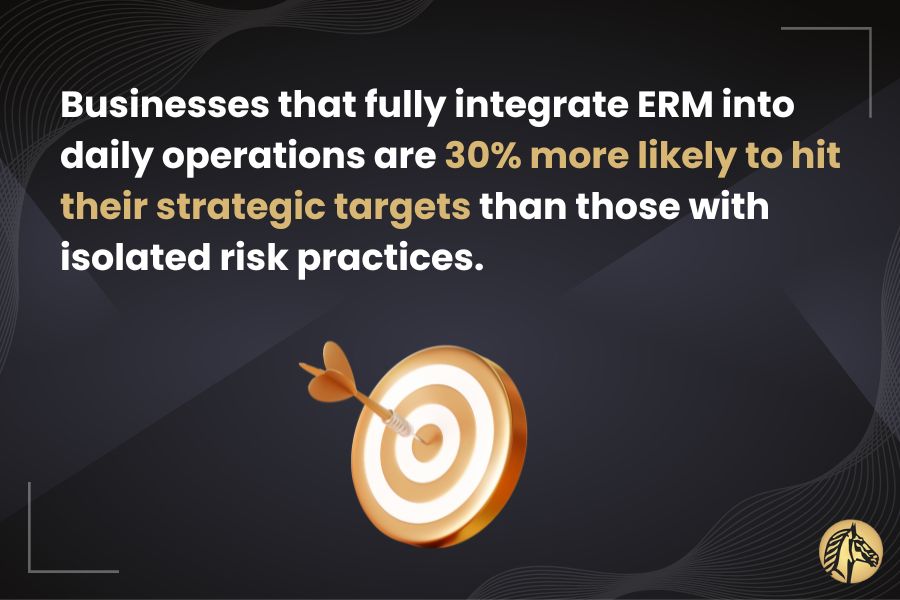
For ERM to remain relevant, it must be integrated into existing business processes rather than operating as a standalone compliance exercise. Studies show that companies with fully integrated ERM programs are 30% more likely to achieve strategic objectives compared to those with siloed risk practices.
Operational integration may involve:
- Incorporating risk considerations into strategic planning
- Linking ERM discussions to budgeting and capital allocation
- Aligning risk reporting with management information
- Promoting risk awareness across operational teams
At Suisse Bank, enterprise risk management is viewed as an ongoing discipline that supports informed judgement over time. Business owners are encouraged to integrate risk considerations into established processes, avoiding unnecessary complexity where it does not add governance value.
Regulatory Alignment and Enterprise Risk Management
Regulatory expectations increasingly emphasise structured risk governance, particularly for organizations operating across multiple jurisdictions or within regulated sectors.
While requirements vary, regulators commonly expect:
- Documented risk management frameworks
- Evidence of senior oversight
- Clear accountability for risk ownership
- Ongoing monitoring and reporting
Suisse Bank assesses ERM frameworks through the lens of regulatory alignment, recognising that effective risk governance supports compliance while allowing organizations to pursue legitimate business objectives within defined parameters.
Monitoring, Reporting, and Ongoing Review
Risk environments evolve, and enterprise risk management frameworks must be capable of adapting accordingly. Ongoing monitoring and review are therefore essential components of ERM.
Key practices typically include:
- Periodic risk assessments
- Defined key risk indicators
- Regular reporting to senior stakeholders
- Internal review or assurance activities
From Suisse Bank’s perspective, the effectiveness of ERM is shaped by sustained oversight and review rather than initial framework design alone.
Enterprise Risk Management and Long‑Term Resilience
Enterprise risk management does not eliminate uncertainty. Instead, it provides a structured approach to understanding and managing risk within established governance boundaries.
Suisse Bank views ERM as most effective when tailored to the organization’s scale, complexity, and regulatory context. Adoption is guided by proportionality, governance discipline, and alignment with long‑term objectives, rather than assumptions about outcomes.
Conclusion: A Disciplined Approach to Enterprise Risk Management
Implementing enterprise risk management is a governance decision that requires clear oversight, defined responsibilities, and ongoing commitment. For business owners, ERM offers a structured framework for assessing and managing risk in a manner that supports transparency and informed decision‑making.
Suisse Bank approaches enterprise risk management as a disciplined practice grounded in governance, regulatory alignment, and responsible evaluation. Clients ultimately determine how ERM is designed and applied within their organisations. When implemented under appropriate governance arrangements, ERM can form part of a broader approach to resilience, accountability, and prudent long‑term management.