
International bank transfers enable individuals and businesses to move funds across borders as part of global financial activity. As digital commerce, remote services, and cross-border trade continue to expand, the ability to send money internationally has become a practical requirement rather than a specialized function.
Unlike domestic transfers, international transfers involve foreign currency, multiple banking systems, and regulatory frameworks that vary by destination country. These differences influence processing time, total cost, and settlement reliability.
Understanding how international bank transfers work helps you manage expectations, timelines, and costs before you send. This guide covers the steps, fees, timelines and checks involved.
Benefits of International Money Transfers
International money transfers support a wide range of personal and commercial needs, from education expenses and relocation costs to supplier payments and professional services.
For globally active clients, cross-border payments also call for careful attention to settlement risk, cost predictability, and compliance.
How an International Wire Transfer Works
International transfers rely on standardized messaging systems, regulatory checks, and settlement processes that differ substantially from domestic wires. Multiple banks and payment networks are typically involved.
Core Transfer Process
The international wire transfer process generally involves initiation, interbank communication, and settlement. Once a sender submits a transfer request, the sending institution verifies the information and transmits instructions to the receiving bank through established financial messaging networks, such as SWIFT. In a SWIFT transfer, the network only carries the payment instructions. It does not hold or move the money, which settles between banks through the accounts they keep with each other.
To initiate an international electronic funds transfer, senders must provide accurate recipient information, including full legal name, address, the receiving bank’s name and SWIFT/BIC code, and an account number or IBAN. Inaccurate information is a common cause of delays and payment failures.
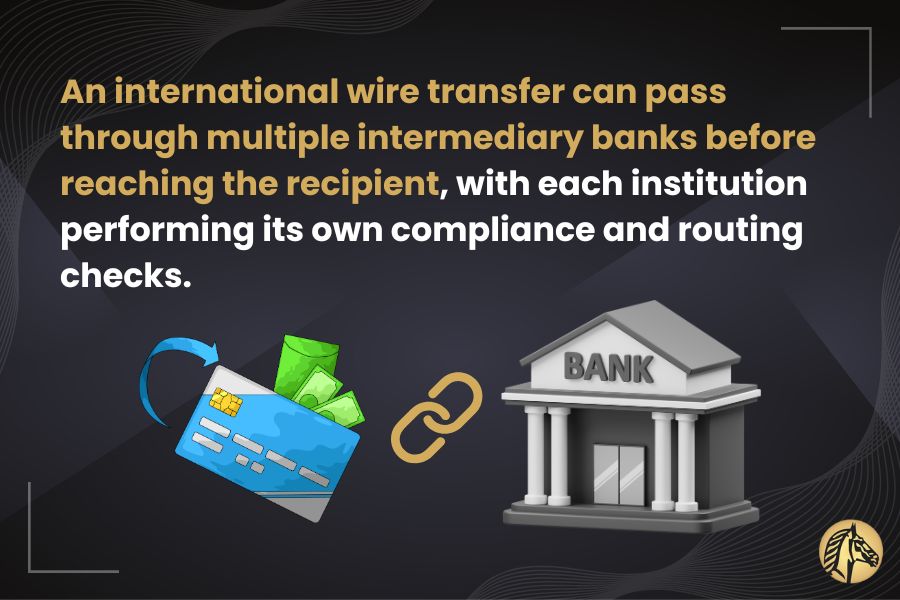
Funds may pass through one or more intermediary banks, often called correspondent banks, which connect two banks that do not hold accounts with each other, before reaching the receiving institution. Once settlement is completed, the recipient’s bank credits the funds. International wire transfers are difficult to reverse once processed, making accuracy and confirmation essential.
Exchange Rate and Foreign Currency
Currency conversion plays a central role in international transfers and directly affects total cost. Many providers add a markup to the mid-market rate, so the exchange rate you are quoted is often less favorable than the one you see online.
If you pay suppliers or send money regularly, even a small spread adds up over time.
Currency conversion can also extend processing timelines, especially when multiple intermediaries are involved. Understanding foreign currency exposure is essential for planning international payments and managing budget expectations.
Bank Account Requirements
For a bank-to-bank transfer, both the sender and the recipient need a valid bank account. Account type, jurisdiction, and verification status may affect transfer limits, processing timelines, and applicable fees.
Discrepancies between account holder names and registration details may result in delays or rejected transfers.
Destination Country and Transfer Restrictions
The destination country plays a significant role in international transfer processing. Some jurisdictions impose restrictions on inbound transfers, documentation requirements, or currency controls. Sanctions can also block payments to or from certain countries. Suisse Bank, for example, cannot process payments to or from the prohibited jurisdictions it lists publicly.
Local bank holidays can delay international transfers, as banks typically do not process payments on public holidays. Transfers initiated outside standard banking hours, or after your bank’s cut-off time, may be delayed by one additional business day or more.
International Wire Transfer Fees
International wire transfer fees vary significantly. Sending banks typically apply an outgoing wire transfer fee, which depends on the institution, destination country, and transfer method.
Intermediary banks may deduct additional charges as part of the routing process, and recipient banks may apply separate incoming transfer fees. These costs are often deducted directly from the transferred amount, reducing the final sum received. When you send the payment, you can usually choose who pays the charges: you (OUR), the recipient (BEN) or both of you (SHA). Choosing OUR often helps the recipient receive the full amount, although your bank may charge more for it. Suisse Bank lists its correspondent bank charges for OUR and SHARED instructions on the All-In-One Wallet Fees page.
As a result, the total cost of an international transfer is frequently distributed across multiple parties, making cost predictability more important than headline pricing alone.
International Payments and Trade
International transfers play a central role in global trade and cross-border commerce. When a deal involves a new counterparty or a large amount, an open wire transfer can leave one side exposed. A Documentary Letter of Credit issued by Suisse Bank and advised by top-tier AA+ rated banks can add payment security. Understanding payment flows supports better cash flow planning, settlement forecasting, and exposure management.
Security and Fraud Prevention
International transfers can carry higher fraud risk than domestic ones because of jurisdictional complexity and communication gaps between banks.
Suisse Bank approaches fraud prevention as a shared responsibility between institutions, networks, and clients, supported by anti-money laundering (AML), know-your-customer (KYC) and transaction monitoring frameworks.
Fraud Prevention and Monitoring
Fraud prevention tools include real-time monitoring, behavioral analysis, and automated risk scoring.
You can protect yourself too. Before you send, double-check any new or changed bank details by calling the recipient on a number you already know, and treat urgent requests to change an account as a red flag.
Compliance and Regulations
International wire transfers require strict account identification and verification under anti-money laundering regulations. Compliance with AML and KYC regulations is mandatory. Requirements vary depending on country and service provider. AML and KYC checks may delay transfers but are essential for reducing exposure to fraudulent transactions.
Globally, the Financial Action Task Force (FATF) sets the standard known as Recommendation 16, which requires information about the sender and the recipient to travel with a cross-border payment. In June 2025, the FATF agreed changes to make that information more transparent and to add tools that help protect against fraud. Each country decides how and when it applies the standard, so requirements differ by bank and destination.
Transfer Methods and Options
International transfers can be initiated through online banking, mobile apps, branch networks, debit cards, and other payment methods. Debit cards are often lower cost than credit cards when funding transfers. Same day settlement may be available through select services, while batch-processed ACH transfers usually take longer than same-day options but are often lower in cost. If you also receive money from abroad, see our guide on how to accept international payments.
How Long Does an International Wire Transfer Take?
International wire transfers generally take one to five business days. Processing time varies depending on the banks involved, destination country, currency conversion requirements, and intermediary banks. Most of the extra time usually builds up at the end of the journey. Swift reports that about 90% of cross-border payments sent over its network reach the destination bank within an hour, but crediting the recipient’s account can add more time.
Some fintech services can deliver money faster than traditional banks, with delivery speeds ranging from instant to one or two days. Speed and cost are closely related, with faster transfers often incurring higher fees or exchange rate markups.
Tracking and Monitoring Transfers
Most banks and service providers offer tools to track transfers through online banking or mobile apps. Monitoring transfer status helps identify delays early. Ask your bank for the transfer’s tracking reference. If your bank uses Swift gpi, this is usually a unique end-to-end transaction reference (UETR) that lets you follow the payment across banks.
If delays occur, following up with the sending bank is recommended. Notifying the recipient about expected timelines and required information supports coordination.
International Money Transfer Services
Alternative providers offer international transfer services alongside traditional banks. Delivery speed, fee structures, and exchange rate policies vary by provider and destination. Comparing providers by corridor (the specific pair of sending and receiving countries) rather than by advertised fees helps set realistic expectations.
Best Practices for International Transfers
Best practices include verifying account details, understanding fees, and confirming exchange rates before sending funds, and making sure your account holds enough money to cover both the amount and the fees. Careful review of transfer information helps prevent errors.
Sending International Payments With Suisse Bank
The All-In-One Wallet includes four separate products. Offshore IBANs/Accounts is the one designed for international payments: client-owned, named IBANs and accounts with full transparency, usable worldwide in USD, EUR, GBP, AED and other major currencies.
Third-party payments are supported through SWIFT, SEPA, SEPA Instant, CHAPS, FPS, ACH and FEDWIRE. Digital onboarding takes under 30 minutes, with no specific residency, travel or local business registration required, subject to Suisse Bank’s compliance review. The setup process page walks through each step.
Responsibility for selecting a service provider, managing fees, and overseeing compliance obligations remains with the client.
Ready to Send Money Across Borders With Confidence?
Open your All-In-One Wallet and get client-owned, named IBANs for your international payments. Become a client today and start your digital onboarding.
Frequently Asked Questions
Q1: What is the difference between a SWIFT code and an IBAN?
An IBAN identifies an individual bank account, while a SWIFT/BIC code identifies the bank itself. Many cross-border payments, especially into Europe and the Middle East, need both.
Q2: What should I do if I sent money to the wrong account?
Contact your bank immediately and ask it to send a recall request to the receiving bank, and keep your transfer reference handy. The outcome depends on the receiving bank and often on whether the account holder agrees to return the funds, so recovery is not guaranteed. Some banks also charge a recall or return fee.
Q3: Is it cheaper to send one large transfer than several small ones?
Often, yes, because many fees are fixed or have a minimum. World Bank data for the first quarter of 2025 put the global average total cost at 6.49% for sending USD 200 and 4.26% for USD 500. Those figures cover small remittance-style transfers, so the cost of a business wire will differ. See the World Bank Remittance Prices Worldwide report for details.
Q4: How is a SEPA transfer different from a SWIFT transfer?
SEPA is a payment scheme for euro transfers between participating European countries, and standard SEPA transfers normally credit within one business day. SEPA Instant is designed to complete euro payments within seconds. A SWIFT transfer is the route for payments outside those schemes, such as most payments in other currencies or to countries outside the SEPA area.
Q5: Why does my bank ask for the reason for an international transfer?
Banks often ask for the purpose of a payment, and sometimes for supporting documents such as an invoice or a contract, as part of their anti-money laundering checks. This is more likely with large amounts, new recipients or transfers to higher-risk countries. Give a clear and truthful description, keep your paperwork ready, and answer any follow-up questions quickly. This usually shortens the review and lowers the risk of delays or a rejected payment. Requirements differ by bank and country, so ask your bank which documents it needs for your transfer.